When the city builds the amenities, what is the master community for?
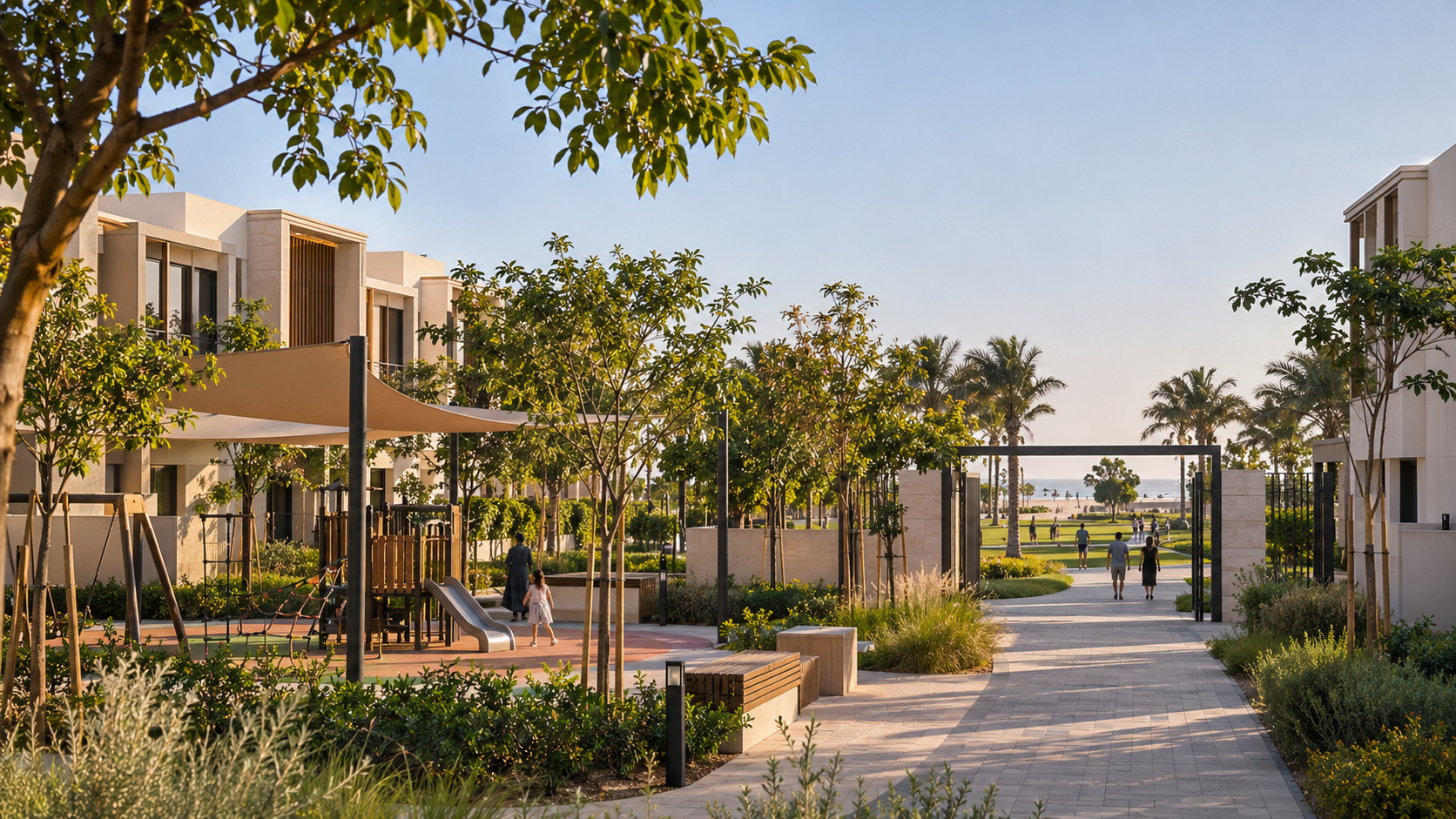
Dubai and Abu Dhabi are building parks, beaches and cycling routes at a pace that changes what residents expect from their own neighbourhoods. The households now collecting keys will judge the shared spaces they pay service charges for against public spaces they do not.
The public offer has moved up a level
In April, the Government of Dubai Media Office announced that Dubai Municipality plans to open 35 new parks this year, with a total investment of AED 348 million, spanning more than 340,000 square metres and serving 23 residential communities. The stated design standard is access within a five-minute walk of surrounding neighbourhoods. The same announcement set out the Blue and Green Spaces Roadmap 2030, a portfolio of more than AED 4 billion to deliver over 120 parks and 200 sports and recreational facilities in the next five years.
The coast is moving in the same direction. In February, Sheikh Hamdan bin Mohammed approved an AED 500 million master plan for Umm Suqeim Beach, designed for up to six million visitors a year. Gulf News describes the wider beach programme as an AED 3 billion plan to increase beach capacity by 170% through phased developments to 2030. By October, Dubai Municipality reported more than 107 public facility projects worth AED 1.6 billion completed in 2026, and said 36% of the investment went to public beaches.
Abu Dhabi is following a similar path. According to Gulf News, the Department of Municipalities and Transport (DMT) delivered 89 parks and 85 kilometres of cycling tracks in 2025.
Government is setting a visible, well-funded benchmark for the public realm, with a walking-distance standard attached, and publishing it as part of a quality of life agenda. That benchmark now sits next to the private amenities developers have promised.
The handover wave meets the benchmark
The timing matters because of who is arriving. Gulf News reports Dubai Land Department figures, cited by industry executives, showing that Dubai delivered 24,537 homes in the first half of 2026, up more than 36% on the 18,043 delivered a year earlier. Aldar handed over almost 2,000 homes in the first nine months, more than double its total for 2025, according to Khaleej Times, and told The National it expects to hand over more than 3,000 units this year and up to 4,500 in 2027. Deyaar reported more than 2,100 units handed over across its Dubai communities since January.
Demand is rotating towards finished homes as well. Khaleej Times, reporting betterhomes data, shows the resale share of Dubai residential sales rising from 24% in the second quarter to 29% in the third. Richard Waind, chief executive of betterhomes, said: "Buyers are showing a clear preference for ready homes they can use or let straight away."
A buyer of a ready home can see what the community is like on a Tuesday evening. A new owner can walk five minutes to a municipal park, then walk back past the community's own playground and pool, and make the comparison in person.
This is where Place Experience Design starts: with the people now living in the place, and whether what they were promised still holds once they can set it beside what the city provides. The timing sharpens the question. The first service charge budgets for many of these communities are being set in the same years that Dubai's park and beach programmes are opening.
Service charges carry the comparison
In Place Experience Design, the service charge and the strata framework are part of the experience, because they are how residents pay for it and hold it to account. Owners already have the tools to ask what they are paying for. Writing in The National in February, Mario Volpi noted that the Dubai Land Department provides a Service Charge Index, that many payments run through the Mollak system, and that challenges usually come from owners acting together: requesting budgets and reviewing vendor contracts.
When the public offer was thin, a master community's amenity package carried its own justification. A pool, a gym, a jogging track and a landscaped park were scarce enough to sell the product and to support the charge. As the city delivers parks within a five-minute walk and beaches designed for millions of visitors, the generic package starts to look like a duplicate of something residents can reach without paying a service charge for it. Maurice Salem, a partner at Arthur D. Little, said in Khaleej Times in July that "the developer's role no longer ends at handover; increasingly they act as long-term curators and operators of the experience". The public realm programme gives that observation a commercial edge.
This is a structural shift in the market, and it reaches developers through no fault of their own. Many of the communities handing over now were planned when the public offer was smaller, and the experience layer buyers were sold assumed a different baseline.
Design for what the city does not do
Place Experience Design works back from the people in the place to the experience, spatial provisions, governance and financial model needed to deliver what the development has promised. The public realm programme changes that brief in three connected ways.
The experience intent has to be defined relative to the public offer. If a municipal park with sports courts sits five minutes away, the community's own open space earns its place by doing something different: serving daily routines at the doorstep, giving children a safe and supervised space, or hosting the programmes that help neighbours know each other. Activation is where a master community can offer what a city park cannot sustain at the scale of a few thousand households. The connection to the public asset, the route, the shade and the gateway, belongs in the community experience design too.
That intent then sets the size of the operational layer. Space and services that duplicate the public offer add cost to the service charge without adding value to the experience. Applied across one major Abu Dhabi master developer's portfolio of 12 projects, Place Experience Design identified a 42% reduction in operational gross floor area (GFA) requirements and AED 252 million in construction cost savings by looking across the portfolio rather than project by project. The same discipline applies when the comparison is with the city's own provision.
Governance and revenue follow from both. A strata and service charge structure that explains what residents receive, and why it differs from the public offer, holds up better under collective scrutiny. Amenity assets designed for revenue from the start can carry part of their own cost.
Technology sharpens each of these choices. DMT now runs ten smart parks with about 1,000 sensors and 200 smart cameras, according to Gulf News, so government is measuring how people use its public spaces. Master communities rarely have the same view of which of their own amenities residents use, at what times, and which they walk past on the way to the municipal park, largely because few were set up to collect it. Usage data of that kind is what turns an amenity package into an experience decision.
In Saudi Arabia, the same shift from building public destinations to operating them is under way: MEED reports that King Salman Park in Riyadh has awarded 95% of the contracts for its first two phases and is now engaging operators. Master communities near destinations of that scale will face the same comparison.
The question for master communities
For developers approaching handover, the governing question of Place Experience Design becomes sharper: does this place work for the people in it, when the city next door is working harder for them too?
The city now builds the park. The master community has to build the reason to stay.
- Government of Dubai Media Office: Dubai Municipality targets delivery of 35 new parks this year with AED348 million outlay, 5 April 2026
- Government of Dubai Media Office: Hamdan bin Mohammed approves master plan to develop Umm Suqeim Beach, 1 February 2026
- Gulf News: Dubai's Dh3 billion beach transformation, 23 April 2026
- Dubai Municipality: Dubai Municipality completes AED 1.6bn in projects, 18 October 2026
- Gulf News: Inside Abu Dhabi's quality-of-life upgrade: 89 parks and 85km cycling tracks, 6 July 2026
- Gulf News: Dubai property buyers get keys months ahead of time, 9 October 2026
- Khaleej Times: Aldar's diversified investments drive 9-month profit to Dh7.1 billion, 27 October 2026
- The National: Aldar to launch major Dubai villa and townhouse project by end of year, 14 October 2026
- Khaleej Times: Deyaar posts 27% profit growth as property handovers exceed 2,100 units, 23 October 2026
- Khaleej Times: Dubai ready-home sales jump 16% as buyers shift away from off-plan properties, 15 October 2026
- The National: UAE property: can owners challenge service charges in Dubai?, 27 February 2026
- Khaleej Times: UAE homebuyers shift to lifestyle-led communities as wellness real estate surges, 13 July 2026
- MEED: Saudi developers pivot to operations, 29 September 2026
The city now builds the park. The master community has to build the reason to stay.


If you want to understand how these frameworks apply to your portfolio
Contact usDownload this quote
The selected quote appears here.